

Introduction
The historical trajectory of Kenya represents one of the most profound and complex tapestries in the global historical record, chronicling the earliest origins of the human species, the intricate migrations of diverse ethnolinguistic groups, the rise and fall of cosmopolitan maritime trading empires, the brutal socio-economic realities of European colonial expropriation, and the turbulent yet highly resilient march toward modern democratic governance. Positioned at the strategic geographical crossroads of the African continent and the Indian Ocean, Kenya’s territorial borders have consistently dictated its role as a vital nexus of cultural exchange, economic exploitation, and political innovation.
- Introduction
- The Cradle of Humankind: Paleoanthropology and Deep History
- Ethnolinguistic Migrations and the Formation of Pre-Colonial Societies
- The Swahili Coast: Commerce, Islamic Culture, and the Indian Ocean Network
- European Incursions: The Portuguese Interlude and Omani Hegemony
- The Architecture of British Imperialism and the “Lunatic Express”
- Settler Capitalism, Land Alienation, and the Legal Apparatus of Oppression
- The Crucible of Resistance: The Mau Mau Uprising and the End of Empire
- The Dawn of Independence and the Kenyatta Era (1963–1978)
- The Shifta War and the Alienation of the Northern Frontier (1963–1967)
- The Moi Autocracy and the Struggle for Multi-Party Democracy (1978–2002)
- Democratic Fragility: The 2007–2008 Post-Election Crisis
- The 2010 Constitution: A Paradigm Shift in Governance
- Economic Ambitions and Fiscal Crises: The Jubilee Era (2013–2022)
- The Ruto Administration, the Gen Z Uprising, and Political Realignment (2022–2025)
- Conclusion
This exhaustive research report provides a granular, expert-level analysis of Kenya’s history. It systematically synthesizes paleontological discoveries that redefine human evolution, pre-colonial socio-economic and political structures, the devastating impacts of British imperialism and land alienation, and the enduring legacies of post-colonial political development. Furthermore, this analysis extends into the contemporary era, evaluating the severe sovereign debt crises of the early twenty-first century, the unprecedented youth-led political mobilization of 2024, and the geopolitical realignments culminating in the broad-based government of 2025. Through a meticulous examination of these epochs, this report articulates the underlying trends, causal relationships, and future implications of Kenya’s enduring historical narrative.
The Cradle of Humankind: Paleoanthropology and Deep History
Kenya’s fossil-rich terrain, particularly within the geographical confines of the Great Rift Valley, has irrefutably established the region as a primary cornerstone in the study of human evolution and paleoanthropology. The unique geological activity of the Rift Valley—characterized by millennia of tectonic shifting, volcanic ash deposition, and sedimentary accumulation—created an optimal, naturally stratified environment for both the preservation and the subsequent exposure of hominin remains. The sheer volume of evidence is staggering; Kenya boasts approximately twenty distinct Miocene sites, a stark contrast to neighboring Ethiopia, which possesses only two. The Miocene epoch, spanning from 23 million to 2.6 million years ago, provides the geological foundation for tracking the divergence of early apes and hominids.
The chronological record of human ancestry in Kenya begins deep in antiquity. The Tugen Hills, located in the Baringo District, yielded the fragmentary bone remains of Orrorin tugenensis, dating back approximately six to seven million years. This discovery marks one of the earliest known hominins to exhibit evidence of bipedalism, fundamentally altering the timeline of human evolutionary biology. Moving forward in the geological timeline, the Turkana Basin in northern Kenya has provided an unprecedented wealth of paleontological evidence, largely due to over five decades of rigorous excavation by the Leakey family, the National Museums of Kenya, and the Turkana Basin Institute.
The Koobi Fora site on the eastern shore of Lake Turkana has proven to be the richest trove of hominin remains globally, producing fossils that represent an estimated 230 distinct individuals. These excavations have unearthed evidence of multiple species of the genus Homo, including Homo habilis, Homo rudolfensis, and Homo erectus, highlighting a complex ecosystem of coexisting hominin lineages. Furthermore, discoveries in the region include Australopithecus anamensis, dating to 4.2 million years ago, and Kenyanthropus platyops, dating to 3.5 million years ago, illustrating the diverse evolutionary branching that occurred during the Pliocene epoch.
A critical breakthrough in resolving evolutionary lineage occurred in 1985 with the discovery of the “Black Skull” by paleoanthropologist Alan Walker in West Turkana. This fossil, identified as Paranthropus aethiopicus and dating back 2.5 million years, provided the crucial morphological link that filled a 17-million-year evolutionary gap between earlier apes, such as the Proconsul, and later hominids, indicating that Paranthropus aethiopicus coexisted with earlier australopithecines. Equally revolutionary was the unearthing of the “Turkana Boy” at Nariokotome, situated on the western side of Lake Turkana. This nearly complete, 1.6-million-year-old skeleton of a juvenile Homo erectus provided scientists with unprecedented insights into early human physiology, growth rates, and the biomechanics of advanced bipedalism.
Beyond physical evolution, Kenya’s archaeological record also provides vital insights into the cognitive, cultural, and sociological development of early human societies. The archaeological cultural timeline of Koobi Fora spans the Pliocene and Pleistocene epochs, featuring the KBS Oldowan stone tool industry (1.89 to 1.65 million years ago) and the subsequent, more sophisticated Karari industry (1.65 to 1.39 million years ago). Additionally, the Nataruk site, located near Lake Turkana, contains the skeletal remains of a nomadic foraging group dating from approximately 10,500 to 9,500 years ago. These remains bear distinct trauma marks indicative of a violent death, including bound wrists and embedded fragments of rare obsidian weapons. This site offers some of the earliest empirical archaeological evidence of intergroup warfare, suggesting that organized human violence and territorial conflict have deep prehistoric roots.
| Hominin Species / Artifact Designation | Approximate Age | Location of Discovery | Evolutionary & Historical Significance |
| Orrorin tugenensis | 6–7 million years ago | Tugen Hills | Represents one of the earliest known bipedal hominins. |
| Australopithecus anamensis | 4.2 million years ago | Turkana Basin | Key transitional link in early hominid bipedal evolution. |
| Kenyanthropus platyops | 3.5 million years ago | West Turkana | Demonstrates early hominid diversity during the Pliocene. |
| Paranthropus aethiopicus (Black Skull) | 2.5 million years ago | West Turkana | Bridged evolutionary timelines; coexisted with early australopithecines. |
| KBS Oldowan Tool Industry | 1.89–1.65 million years ago | Koobi Fora | Early evidence of systematic stone tool manufacturing. |
| Homo erectus (Turkana Boy) | 1.6 million years ago | Nariokotome | Most complete early human skeleton; revolutionized study of physiology. |
| Nataruk Human Remains | 10,500–9,500 years ago | Lake Turkana | Earliest evidence of organized intergroup warfare and weapon trauma. |
Ethnolinguistic Migrations and the Formation of Pre-Colonial Societies
The demographic bedrock of the modern Kenyan state is the direct result of millennia of complex, overlapping migration patterns. The territory sits at the convergence of three major African ethno-linguistic families: the Afro-Asiatic (Cushitic), the Niger-Congo (Bantu), and the Nilo-Saharan (Nilotic). Prior to these massive population shifts, the region was inhabited by indigenous Khoisan-speaking hunter-gatherers, groups possessing languages with dental click affinities akin to the Sandawe and Hadza of Tanzania. These original inhabitants, responsible for the region’s early rock art, were gradually displaced, assimilated, or marginalized by subsequent waves of technologically and numerically superior migrants.
The Cushitic Expansions
The Southern Cushitic speakers represent the first of the major contemporary linguistic groupings to migrate into the Kenyan territory, arriving from the Ethiopian Highlands and the Horn of Africa between 3,000 and 5,000 years ago. Utilizing routes near Lakes Abaya and Turkana, they introduced fundamental pastoralist economies to the East African landscape. Many centuries later, around 1000 AD, Eastern Cushitic speakers also settled in the northern and coastal domains of Kenya. Today, the descendants of these Cushitic migrations—predominantly comprising the Somali, Borana, Rendille, and Gabra communities—continue to inhabit the expansive, arid, and semi-arid lands of northern and eastern Kenya. Their socio-economic structures are highly adapted to nomadic pastoralism, raising resilient livestock such as camels and goats, and their cultures are characterized by strong communal bonds, intricate beadwork, and rich oral traditions.
The Bantu Migrations
Originating from a core center of dispersal in West Africa, Bantu-speaking agriculturalists initiated a massive demographic expansion southward and eastward, entering the Kenyan region roughly 4,000 years ago, with continuous, formalized settlements established between 500 BC and AD 500. The Bantus possessed advanced metallurgical skills—specifically iron-working—and sophisticated agricultural techniques, allowing them to clear forests and cultivate crops such as maize, yams, and beans.
Gravitating toward regions with optimal rainfall and fertile soils, the Bantu populations settled predominantly in the central highlands, the western regions near Lake Victoria, and along the coastal strip. Today, the Bantus constitute the largest demographic sub-group in Kenya, comprising approximately 20 to 22 distinct tribes, including the Kikuyu, Luhya, Kamba, and the nine sub-tribes of the Mijikenda. The territorial expansion of these groups was deliberate and strategic; historical evidence suggests that the Kikuyu systematically spread through their present central territories between 1400 and 1800, a geographical progression that was ultimately checked only by the ecological and military boundaries established by neighboring pastoralist communities.
The Nilotic Movements and State Formation
The third major wave of migration comprised Nilo-Saharan-speaking populations, who originated from the Nile Valley and the regions of present-day South Sudan, moving into the Rift Valley and western Kenya. These populations were deeply diverse in their economic practices, representing a mixture of purely nomadic pastoralists (such as the Maasai, Samburu, and Turkana) and semi-sedentary agro-pastoralists (such as the Kalenjin and Luo). The Southern Luo people, for instance, are recorded as migrating into western Kenya from the territory of present-day Uganda between 1490 and 1517.
Pre-colonial Kenyan societies were generally stateless and highly egalitarian. Economic production was oriented toward collective subsistence and communal survival rather than individualized capital accumulation. Ownership of vital factors of production—including land, water rights, livestock, and labor—was strictly governed by intricate kinship systems and clan affiliations. Labor was cooperative, surplus was minimal, and the egalitarian ideal ensured that vast wealth disparities were rare.
However, there were notable exceptions to this decentralized norm. The Wanga Kingdom, formally established in the late 17th century among the Luhya people of western Kenya, stands out as a rare instance of highly centralized, monarchical state formation. Spanning territories from Jinja in Uganda to Naivasha in Kenya, the Kingdom united diverse factions under the centralized authority of a king, known by the title of Nabongo.
The Swahili Coast: Commerce, Islamic Culture, and the Indian Ocean Network
Concurrent with the consolidation of agricultural and pastoral societies in the deep interior, the Kenyan coastline evolved into a highly sophisticated, urbanized, and cosmopolitan theater of international commerce. From the mid-8th century CE onward, the Swahili culture began to emerge as a dynamic, syncretic identity formed by the intimate interaction between indigenous Bantu farming and fishing communities and foreign merchants—predominantly Arabs from Oman and Yemen, and later, Persians (known as the Shirazi people) arriving in the 12th century.
The very nomenclature of the region reflects this synthesis; the term Swahili is derived from the Arabic word sahil, meaning “coast,” designating the inhabitants as the “people of the coast”. Operating along the shores of the Indian Ocean, the coastal peoples transitioned from localized fishing and agriculture into a highly structured mercantile society. By capitalizing on the reliable seasonal monsoon winds—which propelled Arab dhows to East Africa during the winter and facilitated their return to the northeast in the summer—the Swahili coast became a vital node in a global intercontinental trade network.
Between the 12th and 15th centuries, the coast blossomed into a string of fiercely independent, prosperous city-states, including Mombasa, Malindi, Gedi, Lamu, and Tanga. These enclaves functioned as essential commercial intermediaries. They relied on local mainland tribes to supply sustenance crops such as rice, bananas, yams, and sorghum, while simultaneously extracting valuable African raw materials from the interior—including elephant ivory, gold, ebony, rhinoceros horn, tortoise shells, mangrove poles, and slaves. In exchange, Swahili merchants imported high-value luxury manufactured goods, including Ming Dynasty porcelain from China, silk, Indian cotton textiles, spices, glassware, and fine metal jewelry. The geographic reach of this trade was immense; historical records indicate that in 1418, the legendary Chinese Admiral Zheng He visited Malindi, and recent genetic testing on local populations near Lamu Island has confirmed ancestral links to shipwrecked Chinese sailors from that era.
Culturally and architecturally, the Swahili city-states were defined by their adoption of Sunni Islam, which became the central pillar of Swahili identity by the 12th century. The fusion of cultures produced Kiswahili, a heavily Bantu-based grammatical language infused with extensive Arabic loanwords, which served as the regional lingua franca and remains Kenya’s national language today. The economic prosperity of the ruling mercantile class was reflected in their architecture. Elite domestic housing and mosques were constructed using locally quarried coral blocks cemented with lime mortar. These structures featured long, narrow rooms dictated by the length of the imported mangrove poles used for roofing, and were intricately decorated with carved wooden door frames and imported porcelain bowls embedded into the ceilings and mihrabs.
Despite sharing a common language, religion, and commercial orientation, the Swahili city-states never consolidated into a singular political empire. Instead, they operated as fiercely competitive oligarchies, constantly vying for monopolistic access to the lucrative trade routes of the Great Lakes region and the Indian Ocean.
| Major Swahili City-States | Primary African Exports | Primary Intercontinental Imports | Architectural Characteristics |
| Mombasa, Malindi, Gedi, Lamu | Ivory, Gold, Ebony, Slaves, Mangrove Poles, Tortoise Shells, Frankincense | Ming Porcelain, Silk, Glassware, Spices, Cotton Cloth, Beads | Coral stone construction, mangrove pole roofs, carved wooden doors, integrated porcelain decorations, smaller mosques lacking traditional minarets. |
European Incursions: The Portuguese Interlude and Omani Hegemony
The highly balanced, lucrative geopolitical equilibrium of the Swahili Coast was violently disrupted at the twilight of the 15th century by the arrival of European mercantile imperialism. In April 1498, the Portuguese explorer Vasco da Gama navigated into the harbors of Mombasa and Malindi. Seeking to bypass the Ottoman monopoly on the spice trade and establish absolute maritime dominance over the Indian Ocean, the Portuguese initiated a ruthless campaign of naval bombardment, economic extortion, and the systemic dismantling of the indigenous Swahili mercantile networks. In 1505, Portuguese naval commander Tristão da Cunha led a blockade that forced the capitulation of Lamu, cementing early Portuguese hegemony.
To solidify and protect their tenuous control over these vital maritime choke-points, the Portuguese commissioned the construction of Fort Jesus in Mombasa between 1593 and 1596. Designed by Italian architect and engineer Batista Cairato, the fort was a formidable coral-rock citadel reflecting Renaissance proportions mimicking the human body. Boasting plastered coral walls up to 18 meters high, the star-like, angular bastions were explicitly designed to maximize overlapping fields of cannon fire and ensure that incoming projectiles would ricochet rather than inflict direct structural damage. The Portuguese regarded themselves as martial representatives of Christendom, flying the flag of the Order of Christ; hence, the fortification was named Fort Jesus.
However, Portuguese rule was deeply resented by the local Islamic populations and was characterized by immense political and military volatility. Between 1631 and 1875, Fort Jesus changed hands at least nine times in a series of brutal conflicts between the Portuguese, Omani Arab forces, African Swahili warriors, and eventually British colonialists. The most devastating blow to Portuguese dominance occurred during the epic two-year siege of Fort Jesus (1696–1698) orchestrated by Omani Arabs under the command of Saif bin Sultan. The fall of the fort largely eradicated the Portuguese presence on the Kenyan coast, save for a brief, unsuccessful reoccupation between 1728 and 1729.
Following the Portuguese expulsion, the region fell under the suzerainty of the Sultanate of Oman (which later relocated its seat of power to nearby Zanzibar). The Omani era witnessed a horrific escalation in the East African slave trade between 1830 and 1880, deeply traumatizing interior populations. Ultimately, the lasting legacy of the Portuguese intervention was the permanent fracturing of the Swahili maritime trading states, which never fully recovered their pre-sixteenth-century commercial influence or cosmopolitan wealth.
The Architecture of British Imperialism and the “Lunatic Express”
The late 19th-century geopolitical phenomenon known as the “Scramble for Africa” formalized European territorial ambitions, rapidly shifting Kenya from a coastal trading hub to an internally conquered colonial possession. Following the Berlin Conference of 1884–1885, which arbitrarily partitioned the African continent into European spheres of influence, the British government officially established the East Africa Protectorate in 1895.
Intriguingly, the British colonial apparatus initially viewed the Kenyan interior not as a prized destination possessing intrinsic economic worth, but rather as a vast, hostile geographic obstacle. The true strategic prize was the resource-rich territory of Uganda, which controlled the vital headwaters of the Nile River—the lifeblood of British-controlled Egypt. To secure Uganda against the rival territorial ambitions of the German Empire and the French, the British determined that a massive logistical artery was required.
Thus commenced the construction of the Uganda Railway (1896–1901), stretching over 700 miles from the coastal port of Mombasa across the Rift Valley to the shores of Lake Victoria. In London, the project was fiercely debated and quickly dubbed the “Lunatic Express” by political critics due to its exorbitant £5.5 million cost, the monumental topographical engineering challenges, and the perceived absurdity of building a railway to “nowhere”.
To circumvent their inability to conscript sufficient, compliant indigenous labor, the British colonial administration imported approximately 35,000 Indian laborers to lay the tracks. This mass importation of labor was foundational; many Indian workers chose to remain after their contracts expired, inviting family members and establishing a highly influential Asian mercantile class that deeply impacted Kenya’s subsequent socio-economic development. The construction of the railway was also marked by ecological horror, most famously at the Tsavo River crossing in 1898, where a pair of man-eating lions systematically preyed upon the camps, killing dozens of laborers and severely delaying the project.
Upon its completion in 1901, the Uganda Railway radically transformed the spatial, economic, and political reality of the protectorate. However, the astronomical maintenance and operational costs of the railway necessitated an immediate economic justification. The British administration quickly concluded that traditional African peasant agriculture could not generate the necessary export freight volume to make the railway profitable. Consequently, imperial policy shifted aggressively toward establishing Kenya as a settler colony. The administration actively courted and subsidized white European aristocrats and farmers to settle in the fertile, highly arable Rift Valley and central highlands—an area quickly branded as the “White Highlands”.
Settler Capitalism, Land Alienation, and the Legal Apparatus of Oppression
The transformation of Kenya into a profitable settler colony relied entirely on the systematic, legalized expropriation of indigenous lands and the coerced mobilization of African labor. To facilitate white settlement, the British implemented a draconian legal architecture designed to strip indigenous populations of their ancestral land tenure.
The Crown Lands Ordinances of 1902 and 1915 unilaterally declared all “unoccupied” land as the property of the British Crown, empowering the colonial governor to grant massive freehold leases of up to 999 years exclusively to European settlers, without any consideration for customary African land rights. By 1914, an estimated five million acres of the most fertile agricultural land had been alienated, predominantly from the Kikuyu, Nandi, and Maasai communities.
The Maasai bore the brunt of this early spatial engineering. Under the heavily coercive Anglo-Maasai Treaties of 1904 and 1911, the Maasai were forcibly evicted from the highly prized, well-watered pastures of the Laikipia plateau and confined to desiccated, poorly watered Native Reserves in the southern portion of the country. The British cynically justified these evictions through capitalist paradigms, arguing that indigenous pastoralism did not constitute “productive” land use compared to European commercial speculation. An unprecedented and courageous legal challenge mounted by the Maasai in 1913 against the validity of these treaties was swiftly dismissed by colonial courts, fundamentally demonstrating that indigenous populations could not achieve restitution within an imperial legal apparatus explicitly designed to dispossess them.
Having alienated the land, the colonial state faced an acute shortage of labor; European settlers required vast amounts of cheap labor to cultivate their newly acquired estates, but Africans, still possessing subsistence capabilities in the reserves, were unwilling to work for negligible wages. To break this economic independence, the British implemented a triad of deeply coercive policies :
- Punitive Taxation: The introduction of the Hut Tax (1902) and subsequent poll taxes required mandatory payments strictly in cash. This intentionally forced African men to leave their subsistence farms and enter the colonial wage economy to earn the currency required to pay the state.
- The Kipande System: Formalized by the Native Registration Ordinances of 1915 and 1920, the kipande was a degrading, mandatory identity document worn around the neck by all African males. It contained employment history and fingerprints, acting as an instrument of spatial control that severely restricted freedom of movement and legally prevented laborers from deserting abusive European employers.
- Agricultural Prohibition: To ensure Africans could not generate wealth independently and compete with white farmers, the state legally forbade indigenous populations from cultivating highly profitable global cash crops such as tea, coffee, and sisal.
This socio-economic architecture was devastating. It displaced populations into the “squatter system” on European farms, generated extreme congestion, ecological degradation, and poverty within the Native Reserves, spurred initial rural-to-urban migration (fueling the growth of slums in Nairobi), and fostered deep-seated, systemic racial stratification. On August 13, 1920, recognizing the entrenched power of the white settlers, the territory was officially annexed and elevated from a Protectorate to the Kenya Colony. During World War I, the burden of empire had already exacted a heavy toll, as thousands of Africans were forced to serve as porters and soldiers under the Carrier Corps, dying in massive numbers from disease and exhaustion while agricultural production collapsed, leaving African women to bear the brunt of famine and survival.
The Crucible of Resistance: The Mau Mau Uprising and the End of Empire
The cumulative, generational pressures of absolute land dispossession, forced labor, extreme poverty, and the total denial of political representation ultimately birthed violent resistance. For decades, constitutional political avenues were pursued by organizations such as the Kenya African Union (KAU), led from 1947 by Jomo Kenyatta, an articulate proponent of African rights. However, the consistent failure of peaceful petitions to secure meaningful land reform or political enfranchisement radicalized a younger, militant faction within the KAU.
This militant offshoot coalesced into the Kenya Land and Freedom Army (KLFA)—popularly and pejoratively known by the British as the Mau Mau. Primarily composed of the heavily displaced Kikuyu, Meru, and Embu ethnic groups, alongside supportive units of Kamba and Maasai, the Mau Mau initiated a clandestine campaign of oath-taking to bind communities in unity. By 1952, hundreds of thousands of individuals had sworn the oath, and the movement began launching guerrilla attacks, acts of agricultural sabotage, and assassinations targeted at white settlers and, more frequently, African loyalists and colonial chiefs.
The British response was immediate and overwhelming. On October 20, 1952, Governor Evelyn Baring declared a formal State of Emergency. The following morning, the colonial state launched “Operation Jock Scott,” executing mass arrests of 180 perceived Mau Mau leaders, including Jomo Kenyatta, hoping to decapitate the movement. This strategy failed; the arrests of political moderates pushed the actual militant leadership, including figures like Field Marshal Dedan Kimathi and Stanley Mathenge, deeper into the dense forests of Mount Kenya and the Aberdare Range, where they established a sophisticated insurgency featuring codified disciplinary rules and intricate communication networks.
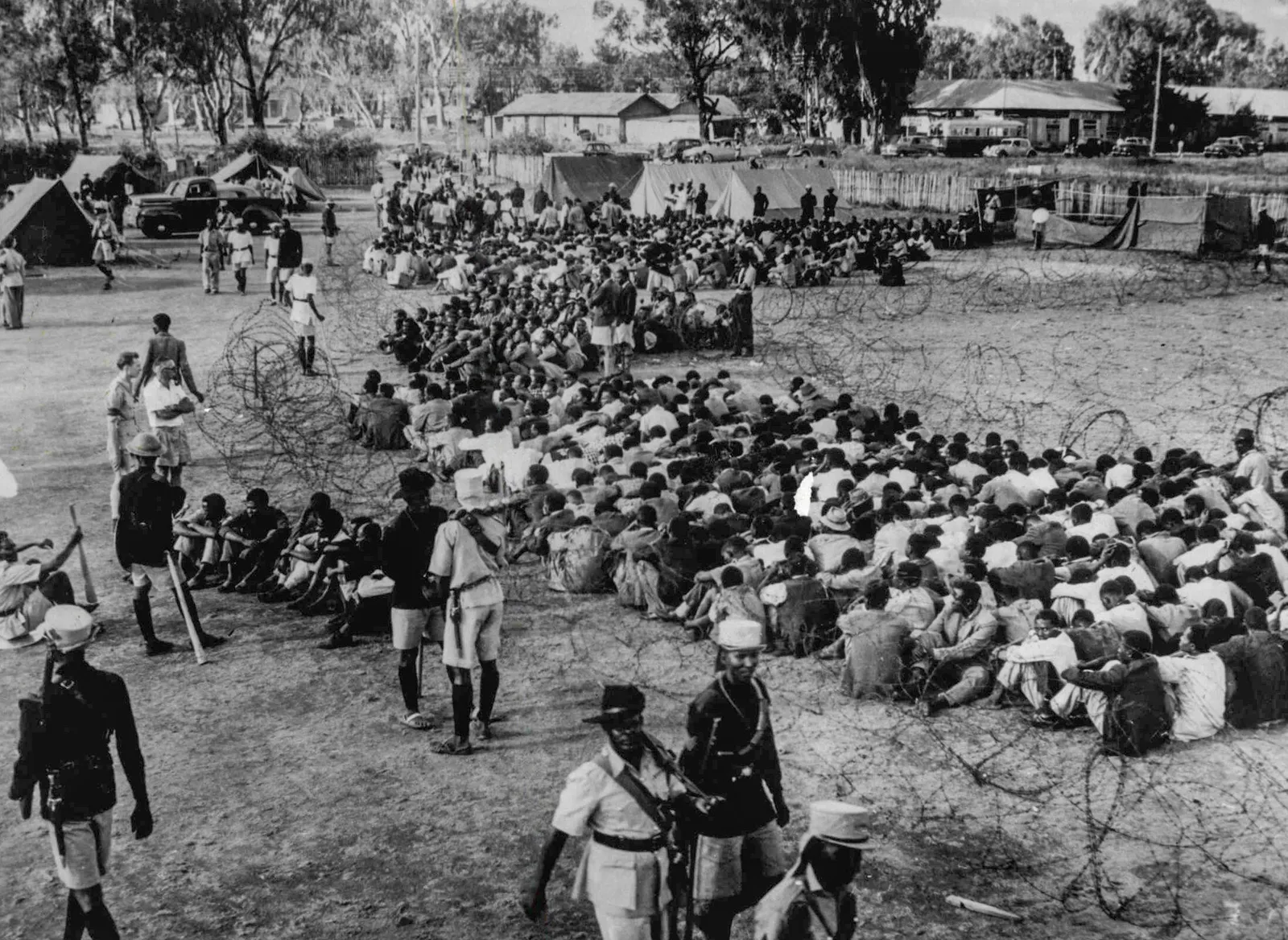
The ensuing conflict (1952–1960) was exceptionally brutal and marked by severe human rights violations. Realizing they could not easily defeat the forest fighters militarily, the British counter-insurgency shifted to punishing the civilian population to sever the guerrillas’ supply lines. The British initiated “Operation Anvil” and established a vast, industrialized network of detention camps and heavily fortified, barbed-wire enclosures known as “The Pipeline”.
Groundbreaking research by Harvard historian Caroline Elkins in her Pulitzer Prize-winning book Imperial Reckoning revealed that nearly the entire Kikuyu population—an estimated 1.5 million people—were interned during the emergency. Within these camps, detainees were subjected to systemic, state-sanctioned atrocities to force them to denounce their anti-British beliefs. The abuses included arbitrary executions, severe malnutrition, extreme forced labor, castration, rape, and psychological torture. The official British statistic of 11,000 Mau Mau fighters killed in combat vastly underestimates the broader civilian mortality caused by the camp conditions.
The capture, trial, and hanging of Dedan Kimathi in October 1956 effectively ended the organized military phase of the uprising. However, the rebellion politically bankrupted the colonial enterprise. The financial, military, and moral cost of maintaining control via mass incarceration proved untenable for the government in London. The Mau Mau uprising fundamentally shattered the myth of white invincibility and hastened the inevitable withdrawal of British rule from East Africa.
Decades later, the legacy of this violence forced a historical reckoning. Following a protracted legal battle, the British government in 2013 formally expressed “sincere regret” for the torture and abuses committed during the colonial era and agreed to a £19.9 million compensation settlement for over 5,000 surviving Kenyan victims, alongside financing a memorial in Nairobi.
The Dawn of Independence and the Kenyatta Era (1963–1978)
Following the lifting of the State of Emergency in 1960, the transition to majority rule accelerated. Jomo Kenyatta was released from prison in 1961, assuming the leadership of the newly formed Kenya African National Union (KANU), a political vehicle designed to transcend tribal politics and negotiate the constitutional framework at the Lancaster House Conferences in London. Kenya officially achieved independence from the United Kingdom on December 12, 1963, initially retaining Queen Elizabeth II as head of state before formally transitioning to a Republic in 1964, with Kenyatta serving as its inaugural President.
The immediate post-colonial government inherited an economy deeply skewed by settler capitalism and a society fractured by colonial ethnic engineering. The era was characterized by a fierce ideological struggle regarding the nation’s economic and geopolitical trajectory amidst the global Cold War.
A central figure in defining Kenya’s post-independence statecraft was Tom Mboya. A brilliant, charismatic trade unionist of Luo descent, Mboya served as the Secretary General of KANU and the Minister of Economic Planning and Development. Prior to independence, Mboya demonstrated immense diplomatic acumen by collaborating with John F. Kennedy and Martin Luther King Jr. to organize the “Kennedy Airlifts” of the late 1950s and early 1960s. This initiative bypassed colonial educational bottlenecks by securing scholarships for hundreds of East African students to study in American universities, successfully building a new cadre of highly educated technocrats equipped to manage the nascent state.
As Minister, Mboya was the principal architect of Kenya’s economic strategy, most notably drafting Sessional Paper No. 10 of 1965, titled “African Socialism and Its Application to Planning in Kenya”. Despite its title, the paper decisively rejected Soviet-style Marxist collectivism in favor of a mixed economy that strongly encouraged foreign direct investment, protected private property rights, and aligned Kenya firmly with Western geopolitical interests.
This pro-Western, capitalist orientation sparked a bitter rivalry with the left-leaning Vice President Jaramogi Oginga Odinga, who advocated for stronger ties with the Soviet bloc and sweeping, radical land redistribution to aid the landless poor. The ideological fracture culminated in Odinga’s resignation and the formation of the opposition Kenya People’s Union (KPU). The assassination of Tom Mboya in July 1969—a devastating blow to the nation’s progressive intellectual leadership—provided Kenyatta the pretext to ban the KPU and arrest Odinga and other leaders.
Following these events, Kenyatta’s administration increasingly centralized power within the executive branch, systematically dismantling the decentralized, federalist “Majimbo” constitution favored by early political rivals. Kenyatta relied heavily on patronage networks deeply dominated by elites from his own Kikuyu ethnic group, effectively transforming Kenya into a de facto one-party state under KANU.
The Shifta War and the Alienation of the Northern Frontier (1963–1967)
While the central government in Nairobi consolidated power and pursued Western-backed economic development, the northern periphery of the state descended into a brutal secessionist conflict. The Northern Frontier District (NFD), populated predominantly by ethnic Somalis, had been treated as an isolated, militarized buffer zone by the British colonial administration. Under the Special Districts Ordinance of 1926, the movement of Somalis was heavily restricted by a pass system, treating their nomadic lifestyle as a constant security threat and artificially separating them from the rest of the colony.
Prior to independence, an overwhelming majority of the NFD population voted in an official plebiscite to secede and join the newly formed Somali Republic. However, bowing to geopolitical pressures and the demands of Kenyan nationalists, the British government reneged on its promises of self-determination, declaring in November 1963 that Kenya’s borders would remain unaltered. When the newly independent Kenyan government ignored the referendum results and exiled the leadership of the Northern Province Progressive Peoples Party (NPPPP), an armed insurgency erupted, initiating the Shifta War (1963–1967).
The term shifta (meaning bandit or rebel) was strategically employed by the state to delegitimize the secessionist movement and criminalize the entire Somali pastoral community. The Kenyan military, supported by British logistics, deployed severe counter-insurgency tactics. The government instituted a State of Emergency in the region, suspending civil liberties, and forced nomadic civilians into “protected villages”—essentially concentration camps—to sever the insurgents’ support base. Furthermore, security forces engaged in the mass slaughter of camel herds and the confiscation of livestock, intentionally crippling the pastoral economy to force the nomads into sedentary submission.
Although a formal ceasefire was brokered in October 1967 by Somali Prime Minister Muhammad Haji Ibrahim Egal at the Arusha Conference, the conflict permanently devastated the regional economy, and the area devolved into decades of dispassionate banditry and chronic underdevelopment. The psychological legacy of the war entrenched a paranoid state policy toward Kenyan Somalis. This suspicion manifested in horrific state violence during the 1980s, including the Garissa massacre (1980) and the Wagalla massacre (1984), where security forces tortured and executed hundreds of civilians. Furthermore, the government implemented draconian ID vetting procedures specifically targeting Somalis, requiring them to prove their ancestry before being issued national identity cards. This systemic marginalization relegated an entire ethnic group to the status of “citizens on probation,” directly echoing the discriminatory logic of the colonial kipande system.
The Moi Autocracy and the Struggle for Multi-Party Democracy (1978–2002)
Following the death of Jomo Kenyatta in August 1978, Vice President Daniel arap Moi, a member of the Kalenjin ethnic group and a former leader of the federalist KADU party, ascended to the presidency. Initially promising to follow in Kenyatta’s nyayos (footsteps) and promising to combat tribalism and corruption, Moi enjoyed a brief honeymoon period bolstered by a boom in global coffee prices that temporarily eased economic tensions. However, recognizing his precarious position among the entrenched Kikuyu elite, Moi systematically pivoted to consolidate his own power base, gradually replacing key administrative, intelligence, and military personnel with Kalenjin loyalists.
Moi’s rule rapidly evolved into an entrenched autocracy. A failed coup d’état orchestrated by elements of the Kenya Air Force in August 1982 provided Moi with the ultimate pretext to eliminate political dissent. He immediately forced an amendment to the Constitution through parliament, officially making KANU the sole legal political party and transforming Kenya into a de jure one-party state. Throughout the 1980s, the state security apparatus engaged in severe political repression; dissident politicians, university lecturers, students, and journalists demanding reform were routinely detained without trial in the infamous Nyayo House torture chambers, or forced into exile.
Moi maintained his grip on power through exceptional political acumen. Nicknamed the “professor of politics,” he expertly utilized state patronage to build cross-ethnic alliances, articulated historical grievances regarding land to galvanize his base, and ruthlessly deployed state sanctions against his opponents.
However, the end of the global Cold War fundamentally eroded Moi’s geopolitical leverage. Western donor nations and multilateral institutions, which had previously overlooked the regime’s human rights abuses in exchange for staunch anti-communist allegiance, began aggressively demanding political liberalization and economic accountability. The breaking point occurred on November 26, 1991, at a Consultative Group meeting in Paris, where international donors collectively suspended $350 million in vital economic aid to Kenya, stipulating that funds would not resume until systemic corruption was curbed and a multi-party system was restored.
Bowing to this crippling economic embargo and sustained domestic agitation from civil society leaders and outspoken diplomats like US Ambassador Smith Hempstone, Moi capitulated, repealing Section 2A of the constitution in December 1991 to legalize opposition parties. Despite the return of multi-party elections, Moi successfully retained the presidency in 1992 and 1997. He capitalized on a deeply fractured and ego-driven opposition, utilizing the first-past-the-post electoral system to win with minor pluralities (37% in 1992 and 40% in 1997). More insidiously, the Moi regime orchestrated and funded politically motivated ethnic clashes in the Rift Valley and coastal regions, utilizing state-sponsored violence to displace opposition voters and maintain minority rule.
| Presidential Administration | Era Dates | Key Political & Economic Characteristics |
| Jomo Kenyatta | 1963–1978 | Independence, centralization of executive power, African Socialism (mixed economy), de facto one-party state. |
| Daniel arap Moi | 1978–2002 | Authoritarianism, 1982 coup attempt, de jure one-party state, political repression, forced return to multi-party democracy (1991). |
| Mwai Kibaki | 2002–2013 | Economic revival, infrastructure investment, catastrophic 2007-2008 post-election violence, promulgation of the progressive 2010 Constitution. |
| Uhuru Kenyatta | 2013–2022 | Massive mega-infrastructure projects (Standard Gauge Railway), exponential growth in national sovereign debt, economic vulnerability. |
| William Ruto | 2022–Present | Debt management, 2024 Gen Z Finance Bill protests, integration of opposition into a broad-based government cabinet (2024-2025). |
Democratic Fragility: The 2007–2008 Post-Election Crisis
Moi constitutionally retired in 2002, allowing a peaceful transfer of power to Mwai Kibaki, whose early tenure was marked by significant economic revival and the introduction of free primary education. However, the fundamental structural flaws of the Kenyan state—ethnic polarization, winner-takes-all politics, and vast inequalities in land ownership—were violently exposed during the December 2007 presidential elections.
The contest pitted the incumbent President Kibaki (representing the Party of National Unity and drawn from the Kikuyu ethnic group) against Raila Odinga (representing the Orange Democratic Movement and drawn from the Luo ethnic group). When the Electoral Commission (ECK) controversially announced Kibaki as the victor under the cover of darkness on December 30, 2007, amidst widespread, internationally verified allegations of electoral manipulation by both sides, the country instantly ruptured.
The crisis escalated rapidly into severe ethnic violence. Initially, supporters of the opposition launched targeted attacks against Kikuyu populations living outside their traditional homelands, particularly in the Rift Valley and western regions. This was swiftly followed by organized, brutal reprisal attacks by Kikuyu militias, and heavy-handed, often lethal police crackdowns on demonstrators. Human Rights Watch documented rampant unlawful killings by Kenyan police utilizing excessive force to quell protests in slums and urban centers.
The resulting humanitarian catastrophe was unprecedented in post-independence Kenya. In just two months, between 1,000 and 1,500 people were killed, and an estimated 600,000 citizens were internally displaced. The crisis brought the nation to the brink of systemic collapse, halted only by a vigorous international mediation effort led by former UN Secretary-General Kofi Annan. After forty days of tense negotiations, the mediation produced a National Accord that established a fragile coalition government, allowing Kibaki to retain the presidency while Odinga assumed the newly created executive role of Prime Minister. The Annan mediation also mandated the creation of a sealed list of primary perpetrators of the violence, which was eventually handed over to the International Criminal Court (ICC) in The Hague, highlighting the deeply entrenched culture of elite impunity that pervaded the Kenyan political establishment.
The 2010 Constitution: A Paradigm Shift in Governance
Recognizing that the 2007 violence was symptomatic of deeper structural flaws rather than merely a disputed election, the coalition government initiated a comprehensive constitutional review process. Promulgated in August 2010 via a national referendum, the new Constitution of Kenya represented the most radical and progressive overhaul of the state’s legal and political architecture since independence.
The most transformative aspect of the 2010 Constitution was the introduction of a two-tier system of devolution. Seeking to dismantle the historically omnipotent executive branch that had fueled ethnic competition for the presidency, the constitution decentralized political power and economic resources from Nairobi to 47 newly created, semi-autonomous County Governments. This structure was explicitly designed to bring government closer to the grassroots, ensuring more equitable resource distribution to historically marginalized regions and mitigating the destructive, “winner-takes-all” nature of national elections.
Additionally, the Constitution established an expansive, legally enforceable Bill of Rights. Moving beyond standard civil liberties, it incorporated second and third-generation socio-economic rights, guaranteeing every citizen the right to accessible housing, reasonable standards of sanitation, and clean, safe water in adequate quantities. The document also initiated a complete overhaul of the judicial branch, mandating the public vetting of all sitting judges to excise corruption and restore public faith in the rule of law. Furthermore, international law was explicitly recognized as a direct source of Kenyan law.
Despite its visionary legal framework, the practical implementation of the 2010 Constitution has faced profound, systemic challenges over the ensuing decade. The devolution of power has been hampered by continuous intra-governmental disputes between the national executive and county governors over the timely allocation of revenue, as well as weak technical capacity and the localized decentralization of corruption at the county level. Furthermore, while the Constitution mandates strict gender equity (stipulating that no more than two-thirds of elected public bodies can be of the same gender), women remain significantly marginalized in practical political and economic spheres due to a lack of gender-disaggregated data, inadequate gender-responsive budgeting, and deeply entrenched patriarchal norms.
Economic Ambitions and Fiscal Crises: The Jubilee Era (2013–2022)
The 2013 general election brought Uhuru Kenyatta (son of Jomo Kenyatta) and his deputy William Ruto to power under the Jubilee Coalition, narrowly defeating Raila Odinga. Their administration entered office promising to operationalize the “Vision 2030” economic blueprint, prioritizing massive, state-led infrastructural development as the primary catalyst for economic transformation and job creation.
The hallmark of the Kenyatta era was an unprecedented boom in mega-projects, most notably the construction of the Standard Gauge Railway (SGR) connecting the port of Mombasa to Nairobi, alongside extensive expansions in road networks, digital ecosystems, and energy grids. While the economy demonstrated respectable growth rates—averaging around 5% to 6% annually during the mid-2010s—the financing mechanisms utilized to fund these ambitions created a severe fiscal vulnerability.
Kenyatta’s ultimate legacy is deeply complicated by a historic sovereign debt crisis. When he assumed office in 2013, Kenya’s total public debt stood at a manageable $17.95 billion. By the end of his tenure in 2022, the debt stock had ballooned astronomically to approximately $72 billion, driving the debt-to-GDP ratio to nearly 69%. This crisis was exacerbated by an excessive reliance on expensive, short-term external commercial loans and opaque bilateral debt, heavily sourced from China. The resulting debt-servicing obligations—costing over $620 million annually just to Chinese creditors—severely strained the national exchequer, leading the International Monetary Fund to classify Kenya as being at a high risk of debt distress. The immense fiscal pressures, combined with persistent, high-level corruption and rising inflation, largely negated the macroeconomic gains of the infrastructure boom, resulting in a stagnant job market and a sharply increased cost of living for the average Kenyan citizen.
The Ruto Administration, the Gen Z Uprising, and Political Realignment (2022–2025)
William Ruto successfully campaigned on a populist “Hustler Nation” platform, assuming the presidency following the highly contested 2022 elections. He inherited an economy in critical condition, constrained by massive debt-servicing requirements, a rapidly depreciating shilling, depleted foreign exchange reserves, and peaking inflation reaching 9.6%. To stabilize the macroeconomic environment and appease international creditors, Ruto’s administration eliminated fuel and unga (maize flour) subsidies and sought to aggressively expand domestic revenue collection.
This aggressive fiscal posture culminated in the drafting of the deeply controversial 2024 Finance Bill. Seeking to raise an additional $2.7 billion to plug budget deficits, the bill proposed severe, wide-ranging tax hikes on essential commodities, the introduction of a 2.5% motor vehicle tax, and expanded levies explicitly targeting the vast informal sector and the digital economy. Furthermore, the bill contained highly invasive amendments to the Data Protection Act, allowing the Kenya Revenue Authority (KRA) unrestricted access to citizens’ mobile money statements and digital financial data without the requirement of a court order.
The introduction of the bill triggered an unprecedented, generation-defining political mobilization. Driven primarily by “Generation Z”—a demographic heavily burdened by endemic youth unemployment and deeply disillusioned with the traditional, elite-driven, ethnic-based politics of the past—nationwide protests erupted between June and August 2024. Diverging from historical patterns of mobilization, these protests transcended tribal affiliations and bypassed traditional political gatekeepers. Utilizing digital platforms like TikTok and X (formerly Twitter) to organize, fundraise, and disseminate information, the youth circumvented state-aligned traditional media.
Operating under the unified hashtag #RejectFinanceBill2024, the movement escalated dramatically on June 25, 2024, when thousands of demonstrators overwhelmed security forces and successfully stormed the Kenyan Parliament in Nairobi. Faced with mounting civilian casualties from live ammunition used by police, widespread international condemnation, and a profound crisis of state legitimacy, President Ruto capitulated. On June 28, 2024, he formally declined to sign the Finance Bill, signing a standardized Appropriations Bill instead to manage the immediate fiscal shortfall. However, the protests had already mutated; what began as a revolt against taxation transformed into systemic demands for an overhaul of government corruption, elite opulence, and executive accountability, with many protestors openly demanding Ruto’s resignation.
The Broad-Based Government of 2025
To stabilize his imperiled administration in the direct aftermath of the Gen Z uprising, President Ruto orchestrated a radical, Machiavellian political realignment in late 2024 and early 2025. Recognizing the existential threat posed by a unified, leaderless youth movement, Ruto sought to co-opt the traditional opposition establishment. He dissolved his inaugural cabinet and engaged in intense negotiations with his former arch-rival, Raila Odinga, to form a “broad-based government”.
In a historic cooperation agreement anchored on a “10-Point Agenda,” Ruto integrated high-profile stalwarts of Odinga’s Orange Democratic Movement (ODM) directly into the executive. Key opposition figures were awarded highly influential cabinet portfolios: John Mbadi was appointed to the Treasury, Hassan Joho, Wycliffe Oparanya to Cooperatives, and Opiyo Wandayi to Energy. This maneuver effectively decapitated the formal political opposition, absorbing them into the state apparatus and neutralizing immediate parliamentary resistance.
This new political landscape was fundamentally altered by the passing of veteran opposition leader Raila Odinga in late 2024/early 2025. His death created a massive leadership vacuum within ODM and the broader reformist movement. His brother, Senator Oburu Oginga, stepped in as the acting party leader. During Odinga’s emotional funeral proceedings held at the Jaramogi Oginga Odinga University of Science and Technology in Bondo, the newly appointed ODM-allied Cabinet Secretaries publicly vowed to remain deeply embedded within Ruto’s broad-based government. They justified this alliance to their grieving base by asserting that continued cooperation with the state for the sake of national unity was Odinga’s explicit final political directive. The ODM Central Committee formally reaffirmed this commitment, pledging to remain in the coalition until the 2027 general elections.
By late 2025, President Ruto utilized his State of the Nation address to champion the stability supposedly brought by this unity government. He pointed to the successful implementation of the Social Health Authority (SHA)—which expanded healthcare coverage to 27 million Kenyans, replacing the defunct NHIF—and the continuation of the Hustler Fund as indicators of inclusive economic recovery. While the administration claimed to have restored fiscal discipline, stabilized the shilling, and curbed inflation, deep public skepticism regarding systemic corruption, police brutality, and the genuine inclusivity of the broad-based government remained prevalent among the youth demographics that had shaken the state only a year prior.
Conclusion
The history of Kenya is not a simplistic, linear progression, but rather a highly complex series of systemic ruptures, violent extractions, and profound, resilient integrations. From the deep time of hominid evolution in the Great Rift Valley to the cosmopolitan mercantile dynamism of the Swahili Coast, the territory has functioned as a central theater of human innovation and cross-cultural interaction for millennia. The imposition of British colonialism violently reordered the social, economic, and geographic landscape, introducing a harsh system of racial capitalism and systematic land alienation that ultimately provoked the bloody Mau Mau insurgency and necessitated the end of empire.
The post-colonial era, while successfully securing political self-determination, inherited and frequently replicated the authoritarian, exclusionary tendencies of the colonial state apparatus. This was starkly evident in the centralization of power under Kenyatta and Moi, the weaponization of ethnicity for political survival, and the violent, militarized marginalization of peripheries like the Northern Frontier District during the Shifta War. However, the enduring resilience of Kenyan civil society has consistently forced democratic recalibration—from the hard-won return to multi-party politics in 1991 to the visionary, decentralized promises of the 2010 Constitution following the trauma of the 2007 electoral violence.
As of late 2025, the Kenyan state stands at a highly precarious, yet transformative juncture. The demographic weight, economic frustration, and digital fluency of Generation Z, demonstrated so vividly during the 2024 Finance Bill protests, have shattered traditional, elite-driven ethnic political calculations. The subsequent formation of a broad-based government following the death of Raila Odinga indicates a political elite desperately scrambling to maintain equilibrium and protect the status quo through co-optation. To secure its long-term stability and prosperity, the Kenyan state must move beyond the mere recycling of political elites. It must urgently fulfill the socio-economic promises enshrined in its progressive 2010 Constitution, transparently managing its heavy sovereign debt burdens while actively responding to the urgent demands of an increasingly educated, vocal, and deeply impatient populace.