

The Republic of Kenya, positioned strategically on the East African coast, represents one of the most complex and culturally rich nations on the African continent. Its identity is not a singular monolithic construct but a vibrant, evolving synthesis of over forty-seven distinct ethnic communities, centuries of Indian Ocean trade, colonial legacies, and a rapidly accelerating digital transformation. With a population exceeding 56 million, Kenya serves as a microcosm of the broader African experience, where ancient pastoralist traditions coexist with a cutting-edge tech industry and a globally influential athletic dynasty. To understand Kenyan culture is to explore the intricate interplay between the ancestral past and a pragmatic, innovative future.
- Foundations of Kenyan Demographics and Ethnic Composition
- The Bantu Hegemony and Agrarian Heritage
- The Nilotic Influence: From the Nile to the Rift Valley
- Cushitic Resilience and the Northern Frontiers
- The Sociostructural Core: Collectivism and the Harambee Spirit
- Linguistic Dynamics: The Power of Swahili, English, and Sheng
- Rites of Passage: The Lifecycle of the Kenyan Citizen
- Spiritual Life: Coexistence and Syncretism
- The Culinary Experience: From Staples to Coastal Curries
- The Arts: Material Culture and Contemporary Expression
- The Sound of Kenya: From Benga to Gengetone
- The Physiology of Success: The Kenyan Running Dynasty
- Digital Culture: The M-Pesa Revolution
- Contemporary Urban Culture: Gen Z and the Digital Arena
- Conclusion: The Resilient Future of Kenyan Culture
Foundations of Kenyan Demographics and Ethnic Composition
The demographic profile of Kenya is characterized by profound diversity, primarily split among three major linguistic and cultural families: the Bantu, the Nilotic, and the Cushitic groups. While indigenous Africans account for approximately 98% of the population, the remaining 2% is composed of Kenyan Europeans, Kenyan Asians, and Kenyan Arabs, whose historical presence in urban centers and coastal trade hubs has left a lasting imprint on the nation’s architecture, cuisine, and economic structures.
The Bantu Hegemony and Agrarian Heritage
The Bantu people represent the most populous linguistic group, comprising roughly 70% of the Kenyan population. Their migration into the region, which dates back to at least 500 B.C., introduced advanced agricultural techniques and iron-working technology that transformed the East African highlands. The Kikuyu (Gikuyu) are the largest ethnic group within this branch, making up between 17% and 22% of the national total. Historically settled in the fertile volcanic soils surrounding Mount Kenya (Kirinyaga), the Kikuyu maintained an intensive agricultural economy that continues to be a cornerstone of Kenya’s domestic food production and political landscape.
The Luhya and Kamba follow as significant Bantu populations. The Luhya, concentrated in Western Kenya, are themselves an amalgamation of multiple sub-tribes, each contributing to a rich oral tradition and diverse agricultural practices. The Kamba, inhabiting the semi-arid eastern plains, became renowned as master traders and skilled artisans, particularly in wood carving—a craft that has transitioned from traditional utility to a global commercial enterprise. Other influential Bantu groups include the Kisii, noted for their unique soapstone carving industry in Tabaka, and the Meru, who maintain a sophisticated traditional governance system overseen by elders.
| Ethnic Family | Primary Groups | Estimated Population Share | Traditional Lifestyle |
| Bantu | Kikuyu, Luhya, Kamba, Kisii, Meru, Mijikenda | ~70% | Agriculture, Trade, Craftsmanship |
| Nilotic | Luo, Kalenjin, Maasai, Samburu, Turkana | ~25% | Pastoralism, Fishing (Luo), Athletics |
| Cushitic | Somali, Rendille, Borana, Gabbra | ~3% | Nomadic Pastoralism, Desert Resilience |
| Non-African | Kenyan Asians, Arabs, Europeans | ~2% | Commerce, Industry, Tourism |
The Nilotic Influence: From the Nile to the Rift Valley
The Nilotic peoples, originating from the Nile Valley in Sudan, settled primarily in the Rift Valley and the Lake Victoria basin. This family is subdivided into three distinct categories: the Highland Nilotes (Kalenjin), the Plains Nilotes (Maasai, Samburu, Turkana), and the River-Lake Nilotes (Luo). The Luo are unique among Nilotes for their sedentary lifestyle and traditional reliance on the fishing resources of Lake Victoria, which has shaped a culture deeply rooted in maritime lore and intricate musical traditions such as the Nyatiti lyre.
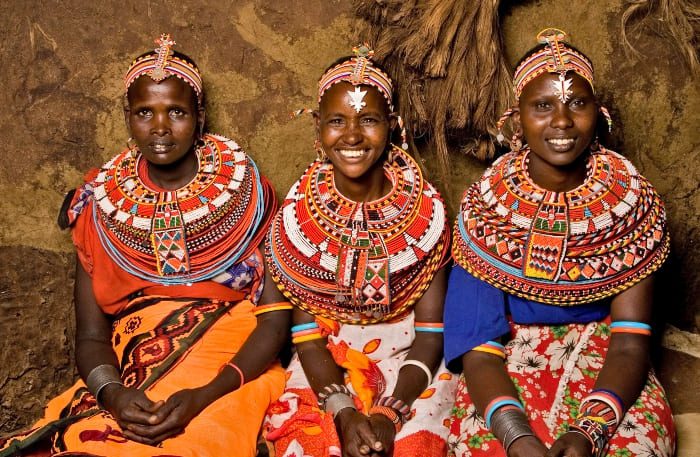
The Kalenjin, a collective of eight sub-tribes including the Nandi and Kipsigis, are globally recognized for their unparalleled dominance in middle- and long-distance running. Their cultural focus on endurance, often fostered through traditional cattle-raiding history and rites of passage, has translated into a modern professional athletic infrastructure. In contrast, the Maasai and Samburu have become the iconic faces of Kenyan traditionalism. By largely rejecting the cash economy in favor of nomadic pastoralism, they have preserved a material culture—characterized by vibrant red shukas and intricate beadwork—that remains resistant to Western assimilation.
Cushitic Resilience and the Northern Frontiers
The Cushitic-speaking groups primarily inhabit the arid and semi-arid lands of Northern and North-Eastern Kenya. Communities like the Somali, Rendille, and Borana have developed sophisticated strategies for managing livestock in environments where water is the most precious commodity. Their social structures are often characterized by complex age-grade systems and deep Islamic influences, particularly among the Somali and Bajuni, which differ significantly from the predominantly Christian Bantu and Nilotic groups of the south.
The Sociostructural Core: Collectivism and the Harambee Spirit
Kenyan society is fundamentally group-oriented, a trait that stands in contrast to the individualism prevalent in Western cultures. This collectivist ethos is anchored by the concept of “Harambee,” a Bantu term meaning “to pull together”.
The Evolution of Harambee
Originally a community-based survival strategy for cooperative tasks like harvesting or house-building, Harambee was elevated to a national philosophy by Jomo Kenyatta upon independence in 1963. It became a mechanism for national development, allowing local communities to pool resources to build schools, clinics, and cattle dips where government funding was insufficient. In the contemporary context, Harambee survives as a powerful social safety net; it is common for families to hold “Harambees” (fundraisers) to cover wedding costs, medical bills, or overseas education fees for a community member. This principle reinforces the idea of mutual responsibility and community self-reliance, ensuring that an individual’s crisis is managed by the collective.
The Extended Family as the Primary Social Unit
The extended family is the bedrock of the Kenyan social fabric, encompassing a wide network of consanguineal (blood) and affinal (marriage) relatives. In traditional Kenyan thought, the family is a continuum that includes the living, the unborn, and the deceased (ancestors). This structure is predominantly patriarchal, with inheritance and lineage typically passing through the male line.
The role of ancestors is particularly nuanced. While not worshipped as deities, ancestors are revered as “living-dead” spirits that require acknowledgement to ensure the harmony of the family unit. Naming traditions often reflect this, with infants named after specific grandparents or deceased relatives to allow the ancestor’s spirit to be remembered and honored through the new life. The breakdown of the extended family in urban settings is often cited as a source of social friction, yet many urbanites maintain strong ties to their rural “home” through frequent visits and financial remittances, a phenomenon supported by the “dual system” of urban-rural mutual support.
Linguistic Dynamics: The Power of Swahili, English, and Sheng
Kenya is a trilingual society at its core, with language use dictated by social context, geography, and class.
The Lingua Francas: Swahili and English
Kiswahili, a Bantu language heavily influenced by Arabic and other Indian Ocean languages, serves as the national language and a vital tool for inter-ethnic communication. It is spoken by nearly the entire population as a second or third language. English, a legacy of British colonial rule, remains the official language for government, law, and higher education. Kenyan English has evolved into a distinct dialect, incorporating local Bantu features and unique idiomatic expressions.
| Language Type | Primary Usage | Socio-Cultural Role |
| English | Government, Law, Education | Official status, global connectivity |
| Kiswahili | Trade, Media, National Identity | Lingua franca, cultural unifying force |
| Ethnic Tongues | Home, Rituals, Rural settings | Preservation of heritage and tribal identity |
| Sheng | Youth, Music, Urban centers | Subversion, rebellion, and street smartness |
Sheng: The Linguistic Rebellion of the Urban Youth
Sheng, a dynamic patois blending Swahili, English, and various ethnic languages (such as Kikuyu and Luo), emerged in the mid-20th century in Nairobi’s Eastlands slums. Initially a secret code for the “wakora” (street-smart youth) to communicate without being understood by authority figures or parents, Sheng has since become a dominant cultural force.
For the modern Kenyan youth, Sheng is more than a slang; it is an identity marker that transcends ethnic boundaries, providing a neutral ground for interaction in a country historically divided by tribal politics. Its evolution is rapid, with new terms emerging and disappearing within weeks, often propelled by the lyrics of Gengetone music. While some educators view Sheng as a threat to formal language proficiency, sociologists argue it represents a sophisticated “cognitive efficiency” and a truly authentic Kenyan linguistic innovation.
Rites of Passage: The Lifecycle of the Kenyan Citizen
Transitions in life are marked by rituals that signify a change in status, responsibility, and relationship to the community.
Circumcision and Male Initiation
Male circumcision is a nearly universal rite of passage among the Nilotic and many Bantu groups, representing the transition from boyhood to manhood. Among the Kalenjin, the Tumdo (initiation) is a months-long process involving seclusion in a menjet (initiation hut). Initiates are taught Kamuratanet—a curriculum of community ethics, survival skills, and ancestral history. The ritual demands absolute stoicism; flinching during the procedure is a mark of lifelong cowardice.
The Maasai Enkipaata and Eunoto ceremonies are perhaps the most famous. Enkipaata initiates boys into the rank of Moran (warrior), while Eunoto marks the transition of junior warriors to senior warriors, characterized by the symbolic shaving of their long, ochre-stained hair by their mothers. These rites are not merely symbolic but serve as crucial educational periods where young men learn their roles as protectors of the community and its livestock.
Marriage: The Covenant of Lineage
In Kenya, marriage is a societal duty rather than a purely romantic endeavor. It is a covenant witnessed by the living and the ancestors, designed to widen kinship networks. The central feature of most Kenyan marriages is the payment of the bride price (dowry).
Among the Agikuyu, the Ruracio (dowry negotiation) is a highly ritualized event where the groom’s family visits the bride’s home multiple times. Euphemistic language is used by elders to negotiate the price, which traditionally included goats, cattle, and honey beer (Muratina), though modern negotiations often include cash and household goods. One playful ritual involves the groom being asked to identify his bride from a group of women completely covered in lessos (traditional cloths); failure to pick her out results in a fine.
| Rite of Passage | Tribe | Key Ceremony/Element | Significance |
| Birth/Naming | Most | Ancestral Naming | Spiritual continuity and lineage |
| Initiation | Kalenjin | Tumdo (Seclusion) | Transformation into a responsible adult |
| Warriorhood | Maasai | Eunoto (Head Shaving) | Graduating to senior status/readiness for marriage |
| Marriage | Agikuyu | Ruracio (Dowry) | Alliance between two clans; legalizing children |
| Death/Funeral | Most | Communal Feasting/Ancestry | Integration into the spirit world; honoring legacy |
Spiritual Life: Coexistence and Syncretism
Kenya is a profoundly religious country, with the 2019 census indicating that over 85% of the population identifies as Christian. However, the religious landscape is characterized by a unique blending of global faiths and indigenous African beliefs.
The Christian Mosaic
Christianity arrived in waves, starting with the Portuguese in the 15th century and followed by intense missionary activity in the 19th and 20th centuries. Roman Catholicism is the largest single denomination, but Protestant and Evangelical churches collectively hold the majority. African Instituted Churches (AICs), such as the Legio Maria or the Akurinu, represent a particularly Kenyan expression of faith, incorporating traditional music, prophecy, and dress into Christian liturgy.
Islam and Coastal Identity
Islam has a long history in Kenya, particularly along the Swahili Coast, where it has been practiced for over a millennium. Most Kenyan Muslims are Sunni of the Shafi’i school, and the faith is deeply integrated into the coastal lifestyle, influencing everything from architecture to the legal structures of the Kadhis’ courts. In regions like Mombasa and Lamu, the call to prayer (Adhan) dictates the rhythm of the day, and festivals like Maulid (celebrating the Prophet’s birth) are major cultural events that draw visitors from across East Africa.
Indigenous Beliefs and Modern Syncretism
Traditional African religions focus on a supreme being who resides in nature, such as the Kikuyu belief in Ngai inhabiting Mount Kenya. While many Kenyans are devout Christians or Muslims, it is common to interweave native beliefs into their practice—a phenomenon known as syncretism. This includes consultations with traditional healers, the use of charms for protection, and rituals to appease the spirits of the deceased.
The Culinary Experience: From Staples to Coastal Curries
Kenyan food culture emphasizes fresh, local ingredients and the communal nature of eating. A meal is rarely just for sustenance; it is a tool for hospitality and social bonding.
The Staples: Ugali and Sukuma Wiki
Ugali, a dense cornmeal porridge, is the undisputed backbone of the Kenyan diet. Made by mixing maize flour with boiling water until it reaches a dough-like consistency, it is typically eaten with the fingers, used as a scoop for stews and vegetables. Its most common companion is Sukuma Wiki (sautéed collard greens with tomatoes and onions). The term Sukuma Wiki literally means “to push the week,” a nod to the dish’s role as an affordable, nutritious staple that helps families survive between paychecks.
Nyama Choma: The Social Ritual
If Ugali is the daily fuel, Nyama Choma (roasted meat) is the celebratory heart. Usually goat or beef roasted slowly over charcoal, it is the center of almost every social gathering. The experience is as much about the atmosphere as the food—friends gather at open-air grills, sharing the meat alongside Kachumbari, a tangy salad of fresh tomatoes, onions, and chili.
Coastal Fusion and Spiced Grains
The coastal region offers a starkly different culinary landscape, defined by centuries of contact with Arab and Indian traders. Coconut milk, cardamom, cloves, and ginger are utilized heavily. Pilau, a fragrant spiced rice dish, and Biryani are coastal treasures that have become popular across the entire country for special occasions. Other influences include Chapatis (flatbreads) and Samosas, which were introduced by Indian laborers during the construction of the Kenya-Uganda railway and are now considered indigenous staples.
| Category | Popular Dish | Description | Cultural Association |
| Staple | Ugali | Maize flour porridge | National backbone |
| Vegetable | Sukuma Wiki | Sautéed collard greens | Resilience and nutrition |
| Protein | Nyama Choma | Slow-roasted goat/beef | Social gatherings |
| Spiced Grain | Pilau | Aromatic rice with meat | Swahili/Indian fusion |
| Breakfast/Snack | Mandazi | Deep-fried sweet dough | Urban street food |
| Traditional Mashed | Mukimo | Potatoes, maize, greens | Kikuyu highland heritage |
The Arts: Material Culture and Contemporary Expression
Kenya’s artistic heritage is a bridge between functional utility and aesthetic storytelling.
Traditional Handicrafts
Traditional Kenyan art is often characterized by its practicality. The Kiondo, a handwoven sisal basket primarily made by Kamba and Kikuyu women, was originally used for carrying farm produce but has evolved into a global fashion accessory. Similarly, Maasai Beadwork is a sophisticated symbolic language; colors and patterns communicate a person’s age, marital status, and social standing.
The Akamba wood carvers are renowned for their intricate sculptures of wildlife and traditional figures, a craft that began as a means of supplemental income in the early 20th century and has since become one of Kenya’s primary cultural exports. In the coastal town of Lamu, woodcarving takes on an Islamic flair, with intricately carved doors and furniture that reflect Swahili geometric traditions rather than representational figures.
Contemporary Art and Urban Street Scenes
Nairobi has emerged as a hub for contemporary African art. The GoDown Arts Centre, a converted warehouse, serves as a multidisciplinary space for artists, dancers, and musicians. The city is also famous for its Matatu Culture—public transport minibuses that are transformed into moving canvases featuring elaborate graffiti, neon lights, and high-tech sound systems. Street art in informal settlements like Kibera uses murals to address social issues such as health, politics, and community resilience.
The Sound of Kenya: From Benga to Gengetone
Music in Kenya is a primary vehicle for social commentary and the preservation of oral history.
The Benga Era: The Sound of Independence
Emerging in the late 1960s among the Luo people, Benga music became the definitive “soundtrack of independence”. Characterized by fast-paced guitar plucking that mimics the traditional Nyatiti lyre, Benga was the first genre to unite the country’s diverse ethnic groups through its infectious rhythm and themes of love and social justice.
The Rise of Genge and Gengetone
In the 1990s and 2000s, the liberalization of the airwaves led to the rise of Genge and Kapuka, which blended American hip-hop with Kenyan themes and Sheng lyrics. This has evolved into the contemporary Gengetone movement—an edgier, more explicit genre that serves as the anthem of Nairobi’s urban youth.
Gengetone is often controversial due to its sexually explicit lyrics and glorification of street life, frequently attracting the attention of the Kenya Film and Classification Board (KFCB). However, for many young Kenyans, it is a form of “aesthetic rebellion” against a system perceived as corrupt or exclusionary. In 2024, Gengetone songs like “Anguka Nayo” became theme songs for political protests, proving the genre’s enduring power as a tool for social mobilization.
The Physiology of Success: The Kenyan Running Dynasty
Kenya’s dominance in middle- and long-distance running is perhaps its most visible cultural export. While often attributed to genetics, the “Kenyan miracle” is the result of a “perfect storm” of geographical, physiological, and sociological factors.
Altitude and Adaptation
Most of Kenya’s elite runners hail from the Rift Valley, living and training at altitudes exceeding 2,000 meters. This “live high, train high” lifestyle stimulates the production of red blood cells and increases aerobic capacity. Biomechanically, many runners from the Kalenjin group exhibit a lean body type with slender ankles and calves, which reduces the energy required for leg swing, making them more economical runners.
The Culture of Movement
Running is an inherent part of daily life for many rural children who must traverse long distances to school. This builds a formidable base of endurance long before formal training begins. Furthermore, the establishment of professional running camps—such as the Rift Valley Athletics Training Centre—has created a sustainable ecosystem where young athletes are mentored by former champions, ensuring that knowledge and training discipline are passed down through generations.
Digital Culture: The M-Pesa Revolution
The introduction of M-Pesa in 2007 by Safaricom has fundamentally altered the social and economic landscape of Kenya.
Financial Inclusion and the “Dual System”
M-Pesa has allowed millions of previously “unbanked” Kenyans to access financial services via their mobile phones. It has strengthened the “dual system” of mutual support between urban workers and their rural families; urban migrants can now send small, frequent remittances to rural homes with the press of a button. This has increased the resilience of rural households against economic shocks.
Empowerment and Innovation
For women, M-Pesa has provided newfound financial autonomy, allowing them to manage their own income and businesses away from traditional family constraints. It has also paved the way for innovative “pay-as-you-go” utility services—such as solar power and clean water—which are essential for improving the quality of life in informal settlements and remote rural areas. M-Pesa is not just a financial tool; it is a cultural artifact that defines modern Kenyan pragmatism and innovation.
Contemporary Urban Culture: Gen Z and the Digital Arena
The year 2024 marked a significant turning point in Kenyan culture with the rise of Generation Z as a political and social force.
Digital Activism and Political Consciousness
Young Kenyans utilized platforms like X (Twitter) and TikTok to mobilize against the 2024 Finance Bill, using humor, satire, and political symbolism to construct a new collective identity. This digital consciousness represents a shift from traditional ethnic-based politics to a more issue-oriented, nationalistic pride.
Sustainable Fashion and Global Reach
The Kenyan fashion scene is increasingly focused on sustainability and “slow fashion”. Designers like Anyango Mpinga and Katungulu Mwendwa incorporate reclaimed materials and traditional craftsmanship into their collections, representing a sophisticated blend of African history and modern global aesthetics. Mpinga’s “30 Shades of Purple” and her anti-human trafficking initiatives demonstrate how Kenyan artists are using their platforms to address global social justice issues.
Conclusion: The Resilient Future of Kenyan Culture
Kenyan culture is a living, breathing entity that refuses to be static. It is a nation where the sound of the Nyatiti still resonates in the melodies of modern pop, and where the ancient spirit of Harambee is facilitated by 5G mobile money networks. From the endurance of the Rift Valley runners to the linguistic subversion of the Nairobi streets, Kenyans have mastered the art of “pulling together” while celebrating their profound diversity. As the country navigates the challenges of the 21st century, its cultural resilience—rooted in family, innovation, and a fierce sense of identity—ensures that Kenya will remain a beacon of creativity and hope in East Africa.